A custom garden flag looks like the simplest thing in the world to order: pick a picture, send it in, wait for the box. In practice it is a small piece of outdoor hardware with a few firm conventions, and the buyers who end up disappointed almost always got one of those conventions wrong rather than the artwork. Before you approve a design, it pays to understand the size that garden flags are built around, how the pole sleeve changes your layout, the real difference between a single-sided and a double-sided flag, and which fabric and print process actually survive a summer outdoors.
The size is nearly standardized, so build to the hardware
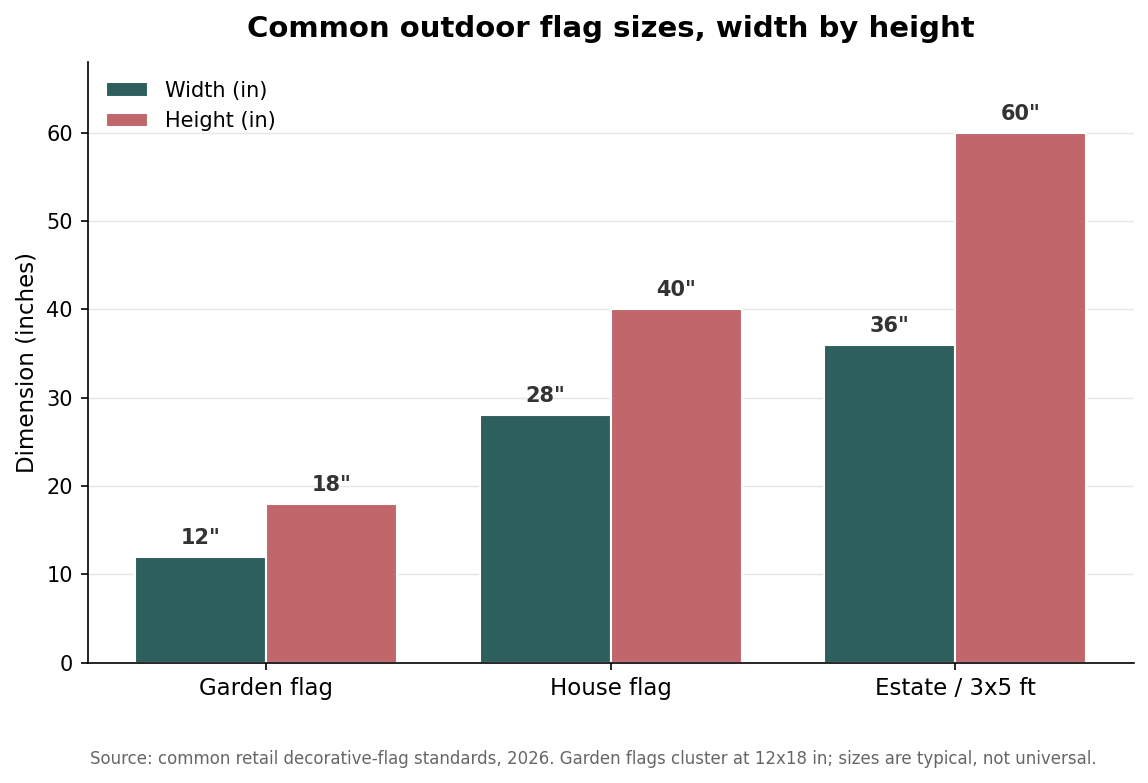
Garden flags are one of the more standardized decorative products you can buy. The overwhelming majority are cut to roughly 12 by 18 inches, with some brands trimming to 12.5 by 18, and they hang from a small metal ground stand with a short horizontal arm. Because the size is so consistent, a flag designed at 12 by 18 will fit almost any stand a customer already owns, which is a large part of why the format sells so well. House flags are a different animal: they are much larger, commonly around 28 by 40 inches, and hang from a wall-mounted bracket rather than a ground stake. Larger estate and 3-by-5-foot flags exist as well, running to 36 by 60 inches and up.
The practical takeaway is to decide up front which product you are actually making. If the goal is a yard accent that fits the stands people already have, design for 12 by 18 and do not improvise a nonstandard size. If you want something read from the street or the porch, you are really designing a house flag, and the mounting hardware and proportions change with it.
Design around the sleeve, not just the rectangle
Every garden flag hangs from a sleeve, or pole pocket, sewn along the top edge that slides over the stand’s horizontal arm. That sleeve typically eats an inch to an inch and a half of the top of the flag, and anything you place up there disappears behind the arm or folds out of view. Keep titles, logos, and faces comfortably below the sleeve, and treat the top strip as dead space. It also helps to remember that a hanging flag furls and sags rather than lying flat like a poster, so a centered focal image reads far better than art that runs edge to edge. Give the design a small margin on all sides so stitching and the natural curl of the fabric do not clip anything important.
Single-reverse and true double-sided are not the same purchase
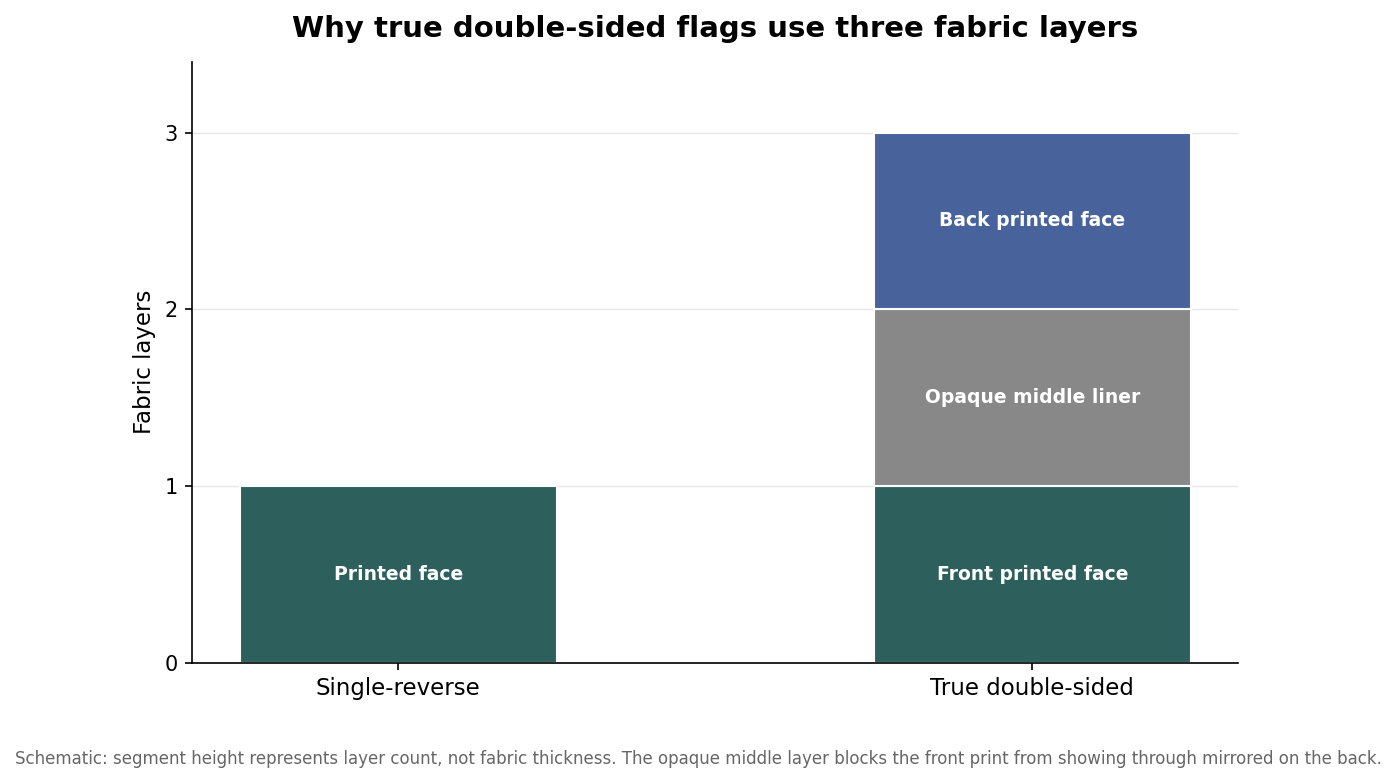
This is the distinction that surprises people most. A single-reverse flag is printed on one face; the ink bleeds partly through the fabric so the back shows a faded, mirror image of the front. That is fine when the flag sits against a wall or is only ever seen from one direction, and it is the cheaper build. A true double-sided flag is constructed from three layers: a printed front, an opaque blocking liner in the middle, and a printed back. The middle layer stops light and ink from passing through, so each face shows its own correct, right-reading image, text included.
The rule of thumb is simple. If the flag will be seen from both sides, such as along a walkway or facing a two-way street, pay for true double-sided so the text is not backwards for half your audience. If it backs onto a fence, porch rail, or wall, single-reverse saves money without anyone noticing.
Fabric and print process decide how long it looks good
Most garden flags are made from polyester, and within that there is meaningful choice. Standard woven polyester is the durable workhorse; a spun, linen-look polyester adds a softer texture; and a faux-burlap weave gives a rustic look that photographs well but tends to fray faster and hold less crisp detail. The dominant printing method for polyester is dye sublimation, where the design is turned to gas under heat and bonded into the fibers rather than sitting on top of them. Because the color becomes part of the fabric, sublimated flags stay vivid and will not crack or peel, and the process runs at roughly 400 degrees for about 60 seconds in production. Double-stitched hems around the edges are worth insisting on, because a single line of stitching is usually the first thing to let go in wind.
Set expectations on fade honestly. Even a well-made sublimated polyester flag will lose some vibrancy after a season or two of direct sun and weather; ultraviolet light is relentless, and no consumer decorative flag is truly fade-proof. Rotating flags seasonally, which most garden-flag buyers do anyway, keeps any one design out of the harshest sun and extends its life. If you want the longest service from a single flag, keep it to standard polyester with sublimated printing and double-stitched edges, and save the textured burlap look for designs you plan to swap out often.
Put together, the decision is short. Choose 12 by 18 unless you are genuinely building a house flag, keep your artwork clear of the top sleeve and give it a margin, pick true double-sided only when the flag is seen from both sides, and specify sublimated polyester with double-stitched hems for the best combination of color and durability. Get those four right and the artwork, which is the part everyone worries about, is free to be the easy part.
Leave a Reply